A complete guide for UK charity trustees on understanding and responding to HMRC Corporation Tax Return notices (CT603)
When HMRC sends a Corporation Tax notice to a charity, you will receive a letter titled "Corporation Tax Notice to Deliver a Corporation Tax Return" (commonly known as a CT603 notice). This official document requests your charity to file a CT600 Corporation Tax return by a specific deadline.
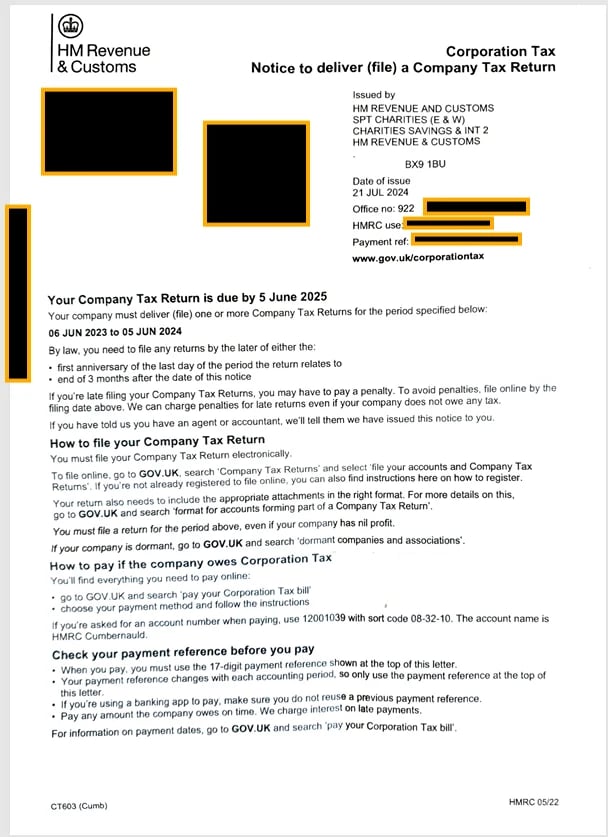
Example of an HMRC Corporation Tax notice showing the filing deadline
Important: The letter will clearly state the filing deadline. Missing this deadline can result in penalties even if no Corporation Tax is due.
There are several common reasons why HMRC may issue a CT603 notice to a charity.
Many charities are registered as charitable companies with Companies House. HMRC's systems may automatically issue Corporation Tax notices to all companies.
HMRC may want confirmation that the charity has no taxable income, qualifies for tax exemptions, and applies income for charitable purposes.
HMRC may issue notices where they believe the charity has trading income, commercial activities, property income, or investment income.
Notices are sometimes automatically generated even where no Corporation Tax is payable. This is common for newly incorporated charities.
Key point: Receiving this letter does not automatically mean the charity owes Corporation Tax. Most UK charities benefit from Corporation Tax exemptions.
There are usually several options available when your charity receives a CT603 notice.
The safest option in many cases is to submit the CT600 return before the deadline, particularly where:
From 01/04/2026: Most charity Corporation Tax returns must be filed electronically using commercial software. There is no longer a free HMRC online filing service. Read HMRC filing guidance
Trustees can contact HMRC directly and explain the charity's situation. This may help where the charity has no taxable income, is fully exempt, or the notice may have been issued in error.
Telephone: 0300 123 1073
Monday to Friday, 8:30am to 5pm excluding bank holidays
In many cases, charities write to HMRC explaining the organisation is a registered charity with no taxable income, and all income is used for charitable purposes.
If HMRC formally removes the notice, the charity normally does not need to file the CT600 return. However, if HMRC refuses to remove the notice, the charity will usually still need to file by the deadline.
Warning: Trustees sometimes assume they do not need to file simply because no tax is due. Unfortunately, HMRC penalties can still apply even where the charity owes no tax.
Ignoring the CT603 notice can create serious problems. Even where no Corporation Tax is payable, HMRC may still issue consequences.
Financial penalties that increase over time
Further notices and escalating communications
Where tax is eventually found to be due
For repeated failures to comply
HMRC expects charities to either file the CT600 return or contact HMRC and resolve the notice formally. Simply ignoring the letter is rarely a good idea.
If your charity receives a CT603 notice, follow these steps:
Ignoring the notice may lead to penalties even where no tax is payable.
The notice normally states the filing deadline clearly.
Consider whether the charity has trading income, rental income, investment income, or taxable gains.
HMRC charity teams can often clarify whether a return is required. Read HMRC charity tax guidance
Charity tax rules can become complicated, especially where charities undertake trading or commercial activities. Contact our team for help.
Receiving an HMRC Corporation Tax return notice can feel stressful for charity trustees, especially for small volunteer run organisations. However, in many cases the charity may not actually owe Corporation Tax.
The key point is this: Do not ignore the letter.
Trustees should either file the CT600 return by the deadline, or contact HMRC and ask them to review or withdraw the notice.
If HMRC removes the notice, filing may no longer be required. If HMRC keeps the notice active, the charity will normally need to submit the Corporation Tax return to avoid penalties.
Because charity tax rules are complex and HMRC filing requirements changed from 01/04/2026, seeking early advice can help charities avoid unnecessary stress, penalties, and compliance issues.
We can help your charity understand its obligations, respond to HMRC properly, and avoid unnecessary penalties. Our team specialises in charity tax matters.