Has your charity received an HMRC letter titled "Corporation Tax Payment Reminder"? Learn what it means, whether you owe tax, and what charity trustees should do.
The HMRC Corporation Tax Payment Reminder letter is an official document from HM Revenue and Customs regarding Corporation Tax for a specific tax period. Below is an example of what this letter looks like.
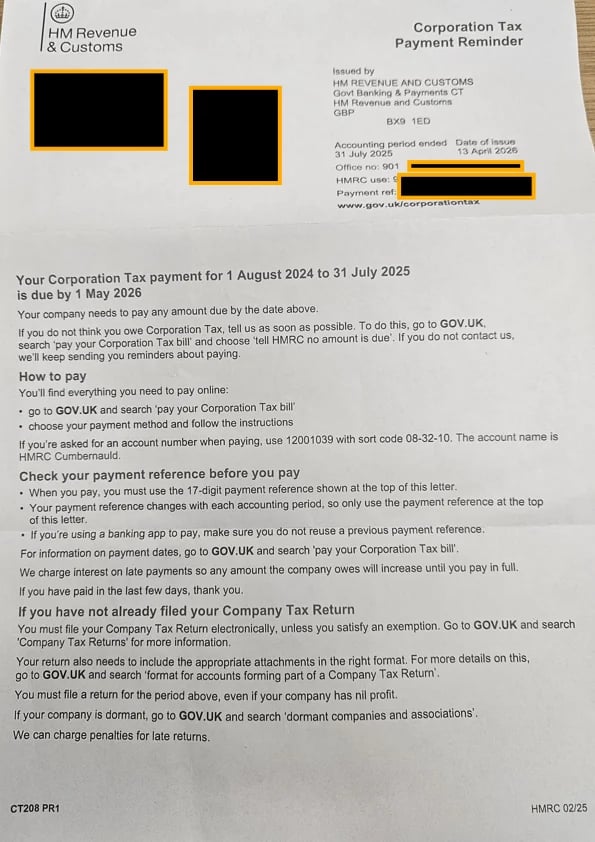
Example of an HMRC Corporation Tax Payment Reminder letter for charities
Important: Receiving this letter does not automatically mean your charity owes Corporation Tax. However, it should never be ignored.
A charity may receive this letter for several reasons:
Many charitable companies are automatically registered within HMRC's Corporation Tax system after incorporation. HMRC may automatically issue reminders even where no tax is payable.
If HMRC has sent a payment reminder, it is very likely HMRC also expects a CT600 Corporation Tax return to be filed for that accounting period.
Important Warning: If HMRC expects a CT600 return and the charity does not file it by the deadline, HMRC can issue late filing penalties even where no tax is payable, the charity made no profit, or the charity is volunteer run.
In many cases, probably not. Most UK charities benefit from charity tax exemptions and do not normally pay Corporation Tax where income is used for charitable purposes.
A charity may not owe Corporation Tax where:
However: Even where no tax is due, HMRC may still expect a CT600 Corporation Tax return to be submitted. This is why reading the full guidance is important.
If the charity does not owe Corporation Tax, trustees can notify HMRC online. HMRC provides an official online service where companies and charities can tell HMRC that no Corporation Tax payment is due.
Tell HMRC no Corporation Tax is due – This may stop further payment reminders where appropriate.
Important: Telling HMRC that no Corporation Tax is payable does not automatically remove the requirement to file a CT600 return.
Many trustees mistakenly believe that because no tax is due, no Corporation Tax return is needed. This is not always correct.
If HMRC has formally requested a Company Tax Return, usually through a CT603 notice, the charity must normally file the CT600 return by the deadline.
Failure to file may result in late filing penalties, additional penalties for repeated late filing, and interest and enforcement action in some cases.
Ignoring the letter can create serious problems for trustees and the charity. Possible consequences include:
HMRC may charge automatic penalties for late CT600 filing
HMRC may continue issuing reminders and warning notices
Repeated failures can create governance concerns for trustees
May trigger further compliance reviews or enquiries
If your charity receives a Corporation Tax payment reminder from HMRC, follow these steps:
Read the letter carefully and note the accounting period dates, filing deadlines, payment deadlines, and Corporation Tax references.
Many charities will have no tax liability because of charity tax exemptions.
Use HMRC's official online form where appropriate.
Even where no tax is payable, a CT600 filing obligation may still exist. Read the detailed guidance.
Charity Corporation Tax rules can be complex. Contact our team for help with charity bookkeeping and tax matters.
Receiving an HMRC Corporation Tax payment reminder does not automatically mean your charity owes Corporation Tax. However, it is an important warning that HMRC may expect action from the charity.
In many cases:
Trustees should review the situation carefully, notify HMRC where appropriate, and ensure all filing obligations are met on time.
Most importantly, do not ignore the letter. If you need help understanding the HMRC notice, checking whether your charity must file a CT600 return, or preparing and filing charity Corporation Tax returns, contact us for professional support.
We can help your charity understand the HMRC notice, check filing obligations, and ensure compliance. Our team specialises in charity tax matters.